Wednesday, 22 April 2015

Two King's Bruton Old Boys killed on the same day, serving with the Canadians at Ypres

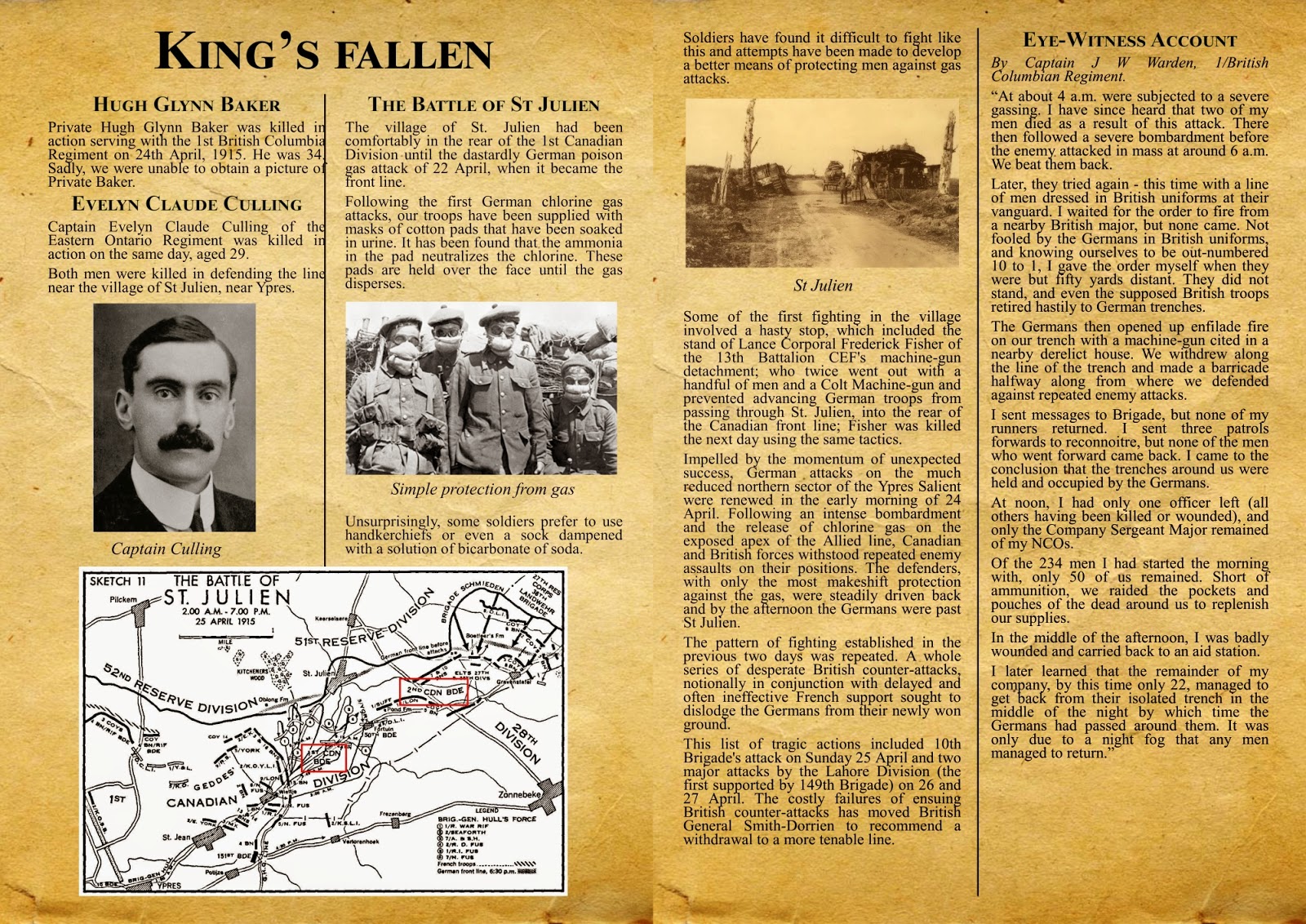
Private Hugh Glynn Baker was killed in action serving with the 1st British Columbia Regiment on 24th April, 1915. He was 34.

Captain Evelyn Claude Culling of the Eastern Ontario Regiment was killed in action on the same day, aged 29.
The 7th Battalion (1st British Columbia) was part of the 2nd Canadian Infantry Brigade. The 2nd Battalion (1st Eastern Ontario) was part of the 1st Canadian Infantry Brigade. Both brigades were part of the 1st Canadian Division, Canadian Expeditionary Force, and fought in France and Flanders until the end of the war. The action at St Julien was their first real taste of fighting on the Western front.
Map of action at St Julien with both Canadian brigades highlighted
 

Both Hugh and Evelyn were killed fighting in what became known as the Battle of St. Julien, itself part of the Second Battle of Ypres which opened on the 22nd April, 1915, with the Germans using chlorine gas against the French in the line around Ypres.

Private Hugh Glynn Baker 

Sadly, I do not have a picture of Private Baker.

Although the war diary for the 1st British Columbia Regiment does not record details of Hugh's death (generally, only the death of officers are recorded by name in unit war diaries), his company officer wrote details about the engagements in which Hugh was killed. It gives a flavour of the wider campaign.


Hugh's body was never recovered.

Captain Evelyn Claude Culling 


Captain Culling


Again, the battalion war diary does not record the particulars of the death of this company commander, however I have reproduced it here anyway. The 2nd Battalion were fighting to the south west of Hugh's battalion, and casualties on the 24th were heavy.


Evelyn's body was never recovered and he, like Hugh, is remembered on the Menin Gate in Ypres.


Tuesday, 10 March 2015

King's Bruton Casualty, Captain John Ramsay Cox of the 1st Battalion, Worcester Regiment

Captain John Ramsay Cox
Captain Cox was killed in action at Neuve Chapelle on 12th March 1915, aged 41.
He was born 29 June, 1873, the son of Captain William Stanley Ramsay Cox and was educated at King's School, Bruton.

Prior to the First World War, he had served with the 6th (Special Reserve) Battalion, Worcestershire Regiment, re-joining early in September, 1914.

Having been attached to the 11th Worcestershire, and temporally employed as a Staff Captain at the 78th Infantry Brigade Headquarters, he proceeded to France in early January, 1915 as part of a draft for the 1st Worcestershire.

It is believed he was killed when his battalion attempted to withdraw from an untenable position in the enemies trenches during the assault at Neuve Chapelle on 12th March. His body has not been found.


The following is an account of the battalion’s action that day.

The trenches in front of Neuve Chapelle held by the 1st Battalion Worcester Regiment were subject to much activity in the run up to the attack. Officers from a number of regiments were sent up in order to reconnoitre the ground in preparation for the great attack planned to commence on the 10th. This attack was intended to smash through the salient in the German line formed by the village of Neuve Chapelle, then hopefully on to take the Aubers Ridge. 

Parties of the 1st Worcestershire were in action shortly after the artillery barrage, the heaviest bombardment yet experienced in the war, lifted to the rear of the village around 8 am. In reserve, however, the main body of the Battalion moved forward later and by the afternoon, two companies were heavily engaged.

The following day was a disaster. Heavy casualties were sustained as the Worcesters advanced, some caused by our own artillery falling short of the enemy lines. 

Before the first daylight of 12 March the enemy's guns heavily shelled the Worcestershire trenches. Then through the mist, a dense mass of infantry were seen surging forward. Two battalions of the 21st Bavarian Reserve Regiment in close formation lead by officers waving swords and, noted one eyewitness, followed by "a fat old blighter on a horse." 

On the right of the Worcestershire, the Sherwoods suddenly fell back. The little salient which their line formed had been attacked from both sides and broken in. This left the Worcester's right flank open, but the Battalion remained unshaken.

'A' Company swiftly formed to the right to face the opened flank and the abandoned trenches of the Foresters. With the Bavarians now within seventy yards, one officer of 'A' Company noted:
"A most extra ordinary hush for a few seconds as we held our fire while they closed in on us. From flank to flank the whole line of the Worcestershire broke into the crackling roar of rapid fire. We brought them down in solid chunks. Down went the officers, the sergeant majors and the old blighter on the horse."

At this point the Worcester's broke from their line and charged into the Bavarians,  bayoneting and firing as they went. Much of the enemy now scattered and found its way into an orchard where the Worcesters had a fine scrap with the Germans. The Worcesters had their tails up with a vengeance. They chased the Germans up and down that muddy field like terriers after rats.

Meanwhile to the left of 'A' Company, 'B', 'C' and 'D' were also engaged in a fierce bayonet fight. The end of which saw the pursued beaten enemy into their own lines. Storming a group of building known as "Point 85", the Worcestershire occupied these. But once again through lack of communication, the British guns inflicted casualties among its own troops with bombardment of the captured area. 

Now isolated, the three companies beat off repeated counter-attacks until at about 10 am, when it had became clear that the Battalion's position, now encircled by the enemy on three sides, was no longer tenable. Reluctantly the Commanding Officer, Colonel E.C.F. Wodehouse gave the order to fall back. 

As the three companies withdrew in good order, officers and men fell fast. The Commanding Officer, the Adjutant, and the last surviving Company Commanders went down, and it was a mere remnant of the three stubborn companies which, still in good order and grimly firing, reached the trenches which they had held at dawn.

Still away to the right, the survivors of 'A' Company, now with hardly any officers, continued the fight in the orchard. But here too, lack of support inevitably forced a withdrawal. The four companies now reunited, the roll was taken and casualties counted.

The day's fighting amounting to a total of three hundred and seventy all ranks.


Trenches at Neuve Chapelle

Wednesday, 25 February 2015

Lt. Commander Robinson, VC

Robinson
Eric Gascoigne Robinson won his Victoria Cross by going ashore on the 26th February, 1915, and single-handedly destroying a Turkish naval gun battery. He was a Lieutenant Commander with the British fleet stationed off the Dardanelles during the Gallipoli campaign.

Admiral John de Robeck wanted to remove the threat of a Turkish gun battery at Orkanieh. This position had withstood fire from the battleships of the Allied fleet during the preceding weeks. Robinson was suggested as the leader of a commando force of sailors and Royal Marines tasked with destroying the battery and withdrawing in good order.

Robinson accepted the mission without hesitation. His force landed undetected early in the morning of 26 February, destroyed two small artillery pieces and made fast progress towards the main battery before being pinned down by Turkish snipers in the mid-afternoon. The white naval uniforms of the sailors proved an easy target for the Turks and casualties mounted as Turkish reinforcements were brought up to cut off the raiding party.

Instead of withdrawing in the face of this threat, Robinson marched his men through gullies and came out close to a small rise behind the main battery. The open ground of the rise was covered by several Turkish snipers, but realising the importance of removing the artillery overlooking the sea passage, Robinson delegated command of the party to a junior officer and made the climb alone, dodging bullets in his white uniform until he crested the rise unhurt, emerging a few minutes later and starting back apparently unconcerned by the increasingly heavy gunfire directed at him. He was said to be "strolling around . . . under heavy rifle fire . . . like a sparrow enjoying a bath from a garden hose".

The battery had been ungarrisoned, and Robinson was able to lay fuses which destroyed the large 9.4" main gun and two anti-aircraft emplacements within the position. Withdrawing in good order, Robinson evaded the Turkish reinforcements and then directed gunfire from the fleet onto their positions, including a force garrisoning an ancient tomb, inflicting heavy casualties. An immediate recommendation for the Victoria Cross was put forward by Admiral de Robeck who had observed proceedings from HMS Queen Elizabeth offshore.


Laying fuses

His citation reads:

Lieutenant-Commander Robinson on the 26th February advanced alone, under heavy fire, into an enemy's gun position, which might well have been occupied, and destroying a four-inch gun, returned to his party for another charge with which the second gun was destroyed. Lieutenant-Commander Robinson would not allow members of his demolition party to accompany him as their white uniforms rendered them very conspicuous. Lieutenant-Commander Robinson took part in four attacks on the minefields - always under heavy fire.

—The London Gazette, 13 August 1915

Had Robinson not won the VC for this action, he would almost certainly have received the award for leading a subsequent night-time action which resulted in the destruction of a stranded British submarine while under intense fire from Turkish shore artillery. He was, instead, promoted Commander.

Monday, 16 February 2015

Chalk Farm to Camberwell Green


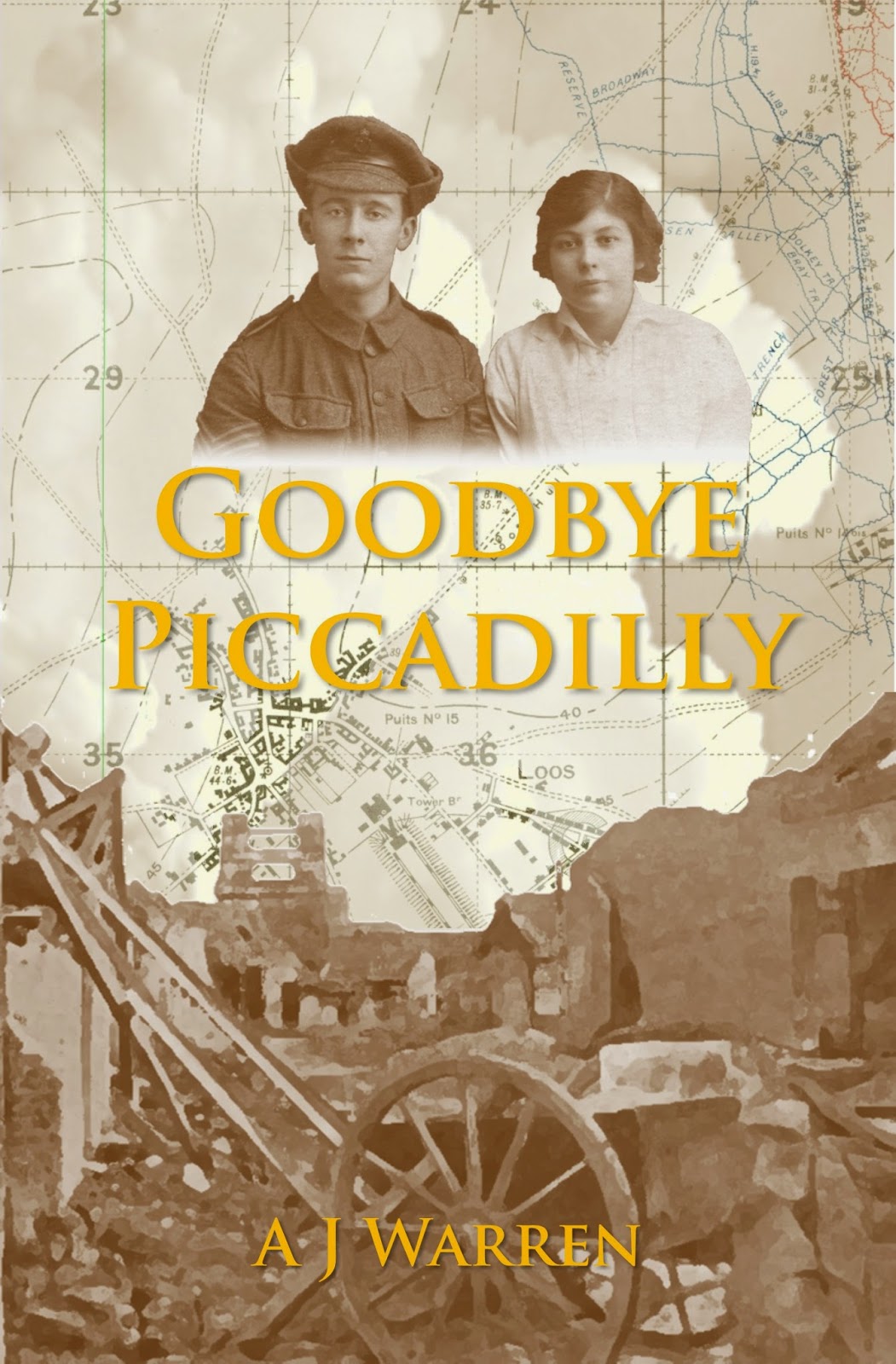
Small excerpt from Goodbye, Piccadilly. Available here: http://www.amazon.co.uk/dp/B00F1YPKKK

***

The train jolted when it crossed some points and Reg woke with a start. It was getting dark outside, he noticed. Most of the lads were either sleeping, or sitting up playing cards or just smoking. Stevens sat by himself in a corner reading. The train began to slow, and Reg assumed they must be arriving at their destination. He stood and walked over to the door. Leaning out, he looked up the track. The train was rounding a gentle bend, and up ahead Reg could see a station and parked alongside, a familiar sight. ‘Bloody hell,’ he said.

‘What?’ said Jimmy. He dropped an unpromising hand of cards, stood up and moved to the door, staggering as the train stopped.

‘Have a look.’ Reg stepped aside and Jimmy leaned out. There must have been around forty London buses parked at the station; there was something very comforting about the sight of them.

‘Looks like we’re getting a lift to the front, lads,’ said Jimmy, mightily relieved he wouldn’t have to march in his new boots. Caldwell appeared out of the gloom as the train stood steaming in the station yard. ‘Kendrick. Let’s have the men down and lined up for the buses.’

‘Sir.’ Reg turned to the men lolling around in the truck. ‘Right. Let’s have the lot of you out double-quick before Mr Caldwell gets cross. Don’t any of you dare to forget your kit. This isn’t Waterloo station, so there’s no lost luggage department. Come on; get a bloody move on, lads!’

Jimmy jumped down, his rifle in one hand. He landed heavily and tried not to show that his feet hurt. The others followed, and Reg organised them into a line. Caldwell walked up and down while Sergeant Reynolds gathered the other two sections from further down the train. Reg saw Caldwell suddenly stiffen to attention; he always did that in the presence of senior officers, and when Reg looked further up the track, sure enough, Connolly was strolling down towards their platoon, the RSM and Captain Hambleton close at heel.

‘Alright, Caldwell?’ said Connolly.

‘Yes, Sir.’

Connolly stepped over towards Reg. ‘Ah, Kendrick. Good journey so far?’

‘Yes, Sir.’ Reg always kept to as few words as possible when dealing with officers, especially senior ones.

‘Chalk Farm to Camberwell Green, eh, Kendrick?’ Connolly added, nodding at the buses.

‘All on a summer’s day, Sir?’ said Reg, holding his hand out to catch the cold drizzle that had just begun to fall.

Connolly laughed, nudging the RSM. ‘A summer’s day, Sergeant Major; that’s good.’ Leary nodded and smiled dutifully, but he’d no idea what the two men were talking about. ‘Well done, Kendrick. A summer’s day, what? Carry on, Caldwell.’

Connolly strolled on down the sidings, stopping occasionally to chat to his men. Reg could hear him explaining the reference to the music hall song to Captain Hambleton who guffawed with laughter when he thought it appropriate.

‘What did he mean, Kendrick?’ said Caldwell who had come up beside Reg.

‘The CO was making a reference to a new music hall song, Sir. Chalk Farm to Camberwell Green, Sir.’

Caldwell looked at Reg as if he were mad.

‘It’s about a girl that takes a bus ride, Sir. To Camberwell Green, Sir. In London.’

Caldwell said nothing, and the men around Reg started to snicker.

‘It’s by Lionel Monckton, Sir,’ Reg said, as if that might explain it all.

‘I don’t care who it’s by, Kendrick, and I very much doubt Colonel Connolly goes to the music hall. I want to know why he took the time to talk to you.’

‘Don’t know, Sir.’ Reg lifted his eyes to look at his officer’s cap badge. Caldwell stared at him, but Reg kept his eyes fixed above those of his platoon commander. After a moment, Caldwell turned and walked away.

Mullins came over to speak with Caldwell; he saluted smartly and delivered his message. Caldwell turned and spoke to his men.

‘Right, everyone, let’s go and get on the buses; our platoon is to take the front two.’

No one moved; it hadn’t sounded like an order.

‘You heard the officer. Get on the buses. Move yourselves; on the double,’ Mullins said, his voice carrying clearly over the noise of the Battalion’s horses being unloaded from a nearby truck. The men ran towards the buses and clambered on.

Mullins walked across the loose gravel to the truck and stood waiting for Johnson’s horse. Johnson wasn’t going to ride it, but he’d want to know it had travelled alright, so Mullins thought he’d have a quick check, although beyond knowing they had a leg on each corner, he knew nothing else about the animals.

Reg climbed up the steps of the front bus, and looked round the men of his section; most were wearing their recently issued goatskins. ‘We look like a bloody circus,’ he said to Jimmy as they both sat down towards the rear of the bus, their packs preventing them from sitting back properly. Jimmy reached into his tunic pocket for his cigarettes.

‘I think we could do with a sing-song, lads,’ said Reg, spotting Caldwell directing the other sections onto the second bus.

Jimmy looked at him.

‘How about Chalk Farm to Camberwell Green?’ Reg grinned at Jimmy.

Once up to London I went for the day, Everything there seemed so lively and gay;’ he began, starting them off. Some of the others laughed and joined in, and soon the whole bus rang to the happy melody.

‘I met a fellow, a regular swell, Said I was looking so rosy and well.’

Much nudging and smiling as the men sang.

‘He whispered kindly: “Now don’t make a fuss, We’ll have a ride on the top of a bus.”

Up came the bus and in front could be seen “Chalk Farm to Camberwell Green”.’

Caldwell stopped in his tracks, turning to stare at the front bus. Connolly walked back towards a bus at the rear, smiling at the men of his battalion as they joined with the chorus as they queued to get on to their own transport; they were in great spirits.

‘Chalk Farm to Camberwell Green, all on a summer’s day;

up we climbed on the motor bus and we started right away.

When we got to the end of the ride, he asked me to go for a walk;

But I wasn’t Camberwell Green by a very long chalk.’

The first bus started up and pulled away. Reg turned to Jimmy, who despite himself, was singing fit to bust a lung, his cigarette stuck behind his ear. Caldwell stepped onto the second bus, the lads there singing louder.

‘Up on a bus it’s so lovely to ride, especially if there’s a chap by your side … ’

Reg craned around, but the boarded-up windows prevented him from seeing Caldwell’s face. He laughed, suddenly happy; but it did seem odd to be going to war in a London bus.
 
***
 
 
For anyone interested in hearing this sung: http://www.youtube.com/watch?v=DWMzkbTdpTE 

Sunday, 15 February 2015

The Amateur Army - Patrick MacGill

MacGill
I did not go to sleep that night; booted and dressed I lay on the hearthrug in front of the fire, and waited for the call. About four o'clock in the morning a whistle was blown outside on the street; I got to my feet, put on my equipment, fastened the buckles of my haversack, bade adieu to my friends of the billet who had risen from bed to see me off, and joined my company.

Five or six regiments were already on the move; transport wagons, driven by khaki-clad drivers with rifles slung over their shoulders, lumbered through the dimly-lighted thoroughfares; ammunition vans stood at every street corner; guns rattled along drawn by straining horses, the sweat steaming from the animals' flanks and withers; an ambulance party sped through the greyness of the foggy morning, accompanied by a Red Cross lorry piled high with chests and stretcher poles, and soldiers in files and fours, in companies and columns, were in movement everywhere—their legions seemed countless and endless.

Ammunition was given out from the powder magazine; each man was handed 150 rounds of ball cartridge—a goodly weight to carry on a long day's march! With our ammunition we were now properly equipped and ready for any emergency. Each individual carried on his person in addition to rifle, bayonet (sword is the military name for the latter weapon) and ball cartridge, a blanket and waterproof sheet, an overcoat, a water-bottle, an entrenching tool and handle, as well as several other lighter necessaries, such as shirts, socks, a knife, fork, and spoon, razor, soap, and towel.

At eight o'clock, when the wintry dawn was breaking and the fog lifting, we entered the stat
ion. Hundreds of the inhabitants of the town came to see us off and cheer us on the long way to Tipperary: and Tipperary meant Berlin. One of the inhabitants, a kindly woman who is loved by the soldiers of my company, to whom she is very good, came to the station as we were leaving, and presented a pair of mittens to each of fifty men.

The train started on its journey, puffed a feeble cloud of smoke into the air, and suddenly came to a dead stop. Heads appeared at the windows, and voices inquired if the engine-driver had taken the wrong turning on the road to Berlin. The train shunted back into the station, and we all went back to our billets again, but not before our officers informed us that we had done the work of entraining very smartly, and when the real call did come we would lose no time on the journey to an unknown destination.

Taken from the Amateur Army by London Irish Rifleman Patrick MacGill

Wednesday, 11 February 2015

King’s Bruton casualty, Arthur Clayton

Arthur Gardner Clayton, Private in Princess Patricia’s Canadian Light Infantry.
Killed in action at La Brasserie, France. 15th Feb 1915, aged 21
Arthur Clayton was a member of New House, and a school Prefect in his final year. He was also a sergeant in the OTC. He was always a very popular boy, being of an extremely affectionate and lovable disposition.

Though not by nature gifted with any great athletic ability, he was a real ‘trier’ and it was by his perseverance and keenness that he became as useful to the school as he undoubtedly was. A keen sportsman, he made his mark playing in both the Hockey and the Cricket XIs.

When he left King’s in July 1911, he moved to Canada where he worked for the Bank of Montreal at Saskatoon, Saskatchewan. Soon after the outbreak of war he enlisted as a Private in Princess Patricia’s Light Infantry, a crack regiment which was singled out by Lord Kitchener for the honour of being the first Canadian regiment selected for service at the Front.

The regiment suffered considerably in February 1915, and Clayton fell near La Brasserie, being killed by shrapnel while on duty in the trenches.

His officer, Lieut. Colquhoun said:

“Private Clayton was a splendid soldier and one of the most popular men in the Company. He proved himself a brave man among brave men, and he died a hero’s death.”

Corporal Leaky, of his Platoon, wrote:

“We all loved him as a gentleman, and as most of us were acquainted with him both in a social and business way in Saskatoon, we feel his loss very deeply.”

These appreciations bear out what was known of Clayton at King’s School, Bruton.

His influence was always for the best.

He lies buried in Voormezeele Enclosure No: 3 Cemetery, alongside, incidentally, George Llewelyn Davies, J.M. Barrie’s ‘real’ Peter Pan.


His younger brother would be killed in 1916.