Thursday, 1 October 2015

The unsung of the Great War - the Battalion Chaplain


“What’s this?” I asked, peeping over the parados to the road in our rear. "My God! There's a transport wagon going along the road!”

“Blimey! You're sprucing,” said Bill, peeping over; then his eye fell on a wagon drawn by two mules going along the highway. “Oh, the damned fools, goin' up that way. They'll not get far.”

The enemy occupied a rise on our right, and a machine gun hidden somewhere near the trench swept that road all night. The gun was quiet all day long; no one ventured along there before dusk. A driver sat in front of the wagon, leaning back a little, a whip in his hand. Beside him sat another soldier. . . . Both were going to their death, the road at a little distance ahead crossed the enemy's trench.

“They have come the wrong way,” I said. “They were going to Loos, I suppose, and took the wrong turning at the Valle Cross-roads. Poor devils!”

A machine gun barked from the rise; we saw the driver of the wagon straighten himself and look round. His companion pointed a finger at the enemy's trench. . . .

“For Christ's sake get off!” Bill shouted at them; but they couldn't hear him, the wagon was more than a quarter of a mile away from our trench.

“Damn it!” exclaimed Bill; “they'll both be killed. There!”

The vehicle halted; the near-side wheeler shook its head, then dropped sideways on the road, and kicked out with its hind legs; the other animal fell on top of it. The driver's whip went flying from his hands, and the man lurched forward and fell on top of the mules. For a moment he lay there, then with a hurried movement he slipped across to the other side of the far animal and disappeared. Our eyes sought the other soldier, but he was gone from sight, probably he had been shot off his seat.

“The damned fools! “I muttered. 'What brought them up that way? “

“Wot's that ? “Bill suddenly exclaimed.

“See, comin' across the fields behind the road! A man, an officer. . . . Another damned fool, and he’ll get a bullet in 'im.”

Bill pointed with his finger, and we looked. Across the fields behind that stretched from the road to the ruined village of Maroc we saw for the moment a man running towards the wagon. We only had a momentary glimpse then. The runner suddenly fell flat into a shell-hole and disappeared from view.

"He's hit,” said Pryor. “There, the beastly machine gun is going again. Who is he? “

We stared tensely at the shell-hole. No sign of movement. . . .

“'E's done in,” said Bill.

Even as he spoke the man who had fallen rose and raced forward for a distance of fifty yards and flung himself flat again. The machine gun barked viciously. . . .

Then followed a tense moment, and again the officer (we now saw that he was an officer) rushed forward for several yards and precipitated himself into a shell-crater. He was drawing nearer the disabled wagon at every rush. The machine gun did not remain silent for a moment now; it spat incessantly at the fields.

“He's trying to reach the wagon,” I said. “I don't envy him his job, but, my God, what pluck! “

“'Oo is 'e?” asked Bill. “'E's not ‘arf a brick, 'ooever 'e is! “

“I think I know who it is,” said Pryor. “It's the Roman Catholic chaplain, Father Lane-Fox. He's a splendid man. He came over with us in the charge, and he helped to carry out the wounded till every man was in. Last night when we went for our rations he was helping the sanitary squad to bury the dead; and the enemy were shelling all the time. He is the pluckiest man in Loos.”

“He wanted to come across in the charge,” I said, “but the Brigadier would not allow him. An hour after we crossed the top I saw him in the second German trench. . . . There he is, up again! “

The chaplain covered a hundred yards in the next spurt; then he flung himself to earth about fifty yards from the wagon. The next lap was the last; he reached the wagon and disappeared. We saw nothing more of him that day. At night when I went down to the dressing-station at Maroc, I was told how the chaplain had brought a wounded transport driver down to the dressing-station after dusk. The driver had got three bullets through his arm, one in his shoulder, one in his foot, and two in the calf of his leg. The driver's mate had been killed; a bullet pierced his brain.

The London Irish love Father Lane-Fox; he visited the men in the trenches daily, and all felt the better for his coming. Often at night the sentry on watch can see a dark form between the lines working with a shovel and spade burying the dead. The bullets whistle by, hissing of death and terror; now and then a bomb whirls in air and bursts loudly; a shell screeches like a bird of prey; the hounds of war rend the earth with frenzied fangs; but indifferent to all the clamour and tumult the solitary digger bends over his work burying the dead.

“It's old Father Lane- Fox,” the sentry will mutter. “He'll be killed one of these fine days."
 
Taken from 'The Great Push' by London Irish Rifleman Patrick MacGill, wounded at Loos in 1915

Saturday, 19 September 2015

Captain Geoffrey Mervyn Underhill Wilson, KIA 25th Sept 1915

Captain Geoffrey Mervyn Underhill Wilson
Old Brutonian Geoffrey Mervyn Underhill Wilson, a captain with the 3rd Batt. Wiltshire Regiment, was killed in action on the first day of the battle of Loos, France, on 25th Sept 1915. He was 21.

Note: although all records (including the Commonwealth War Graves Commission) indicate that Wilson was killed on the 26 September, the War Diary states that he died on the 25 September.

This extract from the battalion war diary provides more detail on his death.

Date: 25/9/1915    Location: France, Verquin 

Battn moved at 12.30am marched via LA BOURSE and SAILLY, arriving at a reserve line of trenches SE of NOYELLES at point L12 o 6.6 at about 3am. Bombardment became intense. At about 6am the attack was launched. Battn ordered to advance through VERMELLES up communication trench (CHAPEL ALLEY) to occupy front line at point G11 o 9.8. Capt King wounded. 2/Lt FH Friend assumed command of 'A' Coy. Following the advance of the 20th Brigade the Battalion occupies the front and support German lines. Lt Col BH Leatham DSO then gave orders for the Battn to advance in open order in direction of CITE ST ELIE keeping to the north of HULLUCH ROAD, our right flank connecting with the 2nd Bedfordshires left. The Battn advanced in the following order, 'B' Coy on the left Capt WM Geddes in command, 'A' Coy on right 2/Lt FH Friend in command, two platoons of each company leading, two platoons immediately behind, 'C' Coy in support, 'D' Coy in reserve, Major RMP Gillson in command of'C' Coy, Capt EC Mudge in command of 'D' Coy, the whole were led by Major CG Forsyth, and experiencing extremely heavy rifle and machine gun fire from the front came to a line held very weakly by a mixture of 8th Devon & 2nd Borders. The trench contained 4 German field guns and ammunition. Our losses were heavy and included the following Officers casualties Capt GMU Wilson, 2/Lts CFB Hodgins JH Clarke WHG Durrant killed. Major RMP Gillson, 2nd Lt FH Friend wounded the latter seriously.
 At dusk the Battn was relieved by the 9/Devonshire Regt and took up a new front at BRESLAU AVENUE our right resting on the latter Regiment.

Read more about the Battle of Loos here: http://thescribblerdotbiz.blogspot.co.uk/2013/09/battle-of-loos.html
 

Monday, 10 August 2015

King's Brutonian Captain John Francis Martyr KIA


Captain Martyr, KIA 11 August 1915

Captain John Francis Martyr, 1st Battalion Royal Irish Rifles (attached to 6th Battalion), died of wounds at Gallipoli 100 years ago today (11/8/1915), aged 33. He was buried at sea.

Captain Martyr had served in the South African War in 1901 and 1902, where he was employed with the Mounted Infantry, and obtained for his valuable services the Queen's Medal with five clasps.

His unit was involved in fierce fighting on the day he was wounded. The 6th (Service Battalion) Royal Irish Rifles War Diary records that the Battalion landed on 5th August 1915 at Anzac Cove with 23 officers and 743 other ranks. 

They advanced on the 8th August via Walkers Ridge, Chailak Dere and Aghyl Dere until they reached a lone and isolated position known as The Farm. From there the 6th Royal Irish Rifles, in its first significant battle with the enemy since formation and training on the Curragh, launched attacks against the Turks occupying positions on the ridges above them. 

They suffered terrible casualties in a charge against the Turks and then in the Turks counter-attack.  The 6th Royal Irish Rifles War Diary explains that on 10th August the Turks counter-attacked and after the battle the Battalion's strength was about 270. Poignantly it records that the casualties (dead, wounded or missing) "as far as can be ascertained" in that one battle on 10th/11th August 1915 amounted to 372 men.

The following is an extract from a report by a company commander there at the battle.

Monday, 22 June 2015

Stringbag over Somerset

W5856 awaits her new paint job
It’s a cold day when I visit the Royal Navy Historic Flight (RNHF) at Yeovilton and I am glad to get into the enormous hangar and out of the bitter wind that drives across the airfield. The Flight’s Commanding Officer, Lieutenant Commander Chris Götke AFC RN, shows me the collection, which includes two Fairey Swordfish, a Hawker Sea Hawk and a Hawker Sea Fury.

The RNHF’s second Sea Fury survived a forced landing following complete engine failure last year during an air display at RNAS Culdrose in Cornwall. The pilot, Lt Cdr Götke, was awarded the Air Force Cross for his bravery and his cool handling of his aircraft.


It is one of the Swordfish I have come to see. There are thought to be only four airworthy Swordfish worldwide, and W5856 is the oldest surviving example. Following a re-spray into 820 Naval Air Squadron colours that take her back in time to 1941, she is at the end of a complete restoration that will see her enter the Flight’s display program this summer.

Nicknamed the Stringbag by their crews because of their ability to carry almost anything, these tough aircraft served from both land and sea in every theatre of war during the Second World War and, perhaps more than any other type, they represent the spirit of naval aviation in the FAA.

Swordfish had a number of significant successes, notably the attack at Taranto in which the Italian navy lost half of its capital ships. They also played a part in crippling the German battleship Bismarck. But perhaps their defining role was the contribution they made during the Battle of the Atlantic in which they shone as anti-submarine aircraft.


W5856 first flew in 1941 and served with the Mediterranean Fleet. Shipped to Canada at the end of the war, she fell into disrepair. In 1990, British Aerospace bought her from the Strathallan Collection in Scotland and, having restored her to pristine flying condition, presented her to the RNHF in 1993.
As we stand next to the enormous biplane, with its 45 foot wingspan, Lt Cdr Götke admits he has yet to fly one. Looking up at it, I ask him whether he intends to remedy this. He just smiles, and it’s clear to me that the pilots who fly for the RNHF do so for the love of the aircraft; for the pure joy of a kind of flying which is fast disappearing: flying by the seat of your pants and with the wind in your hair; quite literally, in the case of the Swordfish.

The Royal Navy has a long history with aviation. In 1909, it ordered its first airship, and just 3 years later, in 1912, the Royal Flying Corps Naval Wing was formed. This went on to become the Royal Naval Air Service in 1914 under which name it served throughout the Great War with distinction. In 1924, this became the Fleet Air Arm (FAA).


I ask Lt Cdr Götke how he finds pilots to fly these old warbirds. He assures me there is no shortage of volunteers, and so the Flight can afford to be choosy. Pilots selected to display the aircraft hone their skills on less valuable planes with similar handling characteristics. These include the de Havilland Chipmunk, a North American Texan, a BAC Jet Provost and the BAE Hawk.
The powerful radial engine after its rebuild
He leads me over to an enormous radial engine which stands on its own to one side of the hangar. It is about to be refitted to W5856 following a total rebuild. How, I wonder, does the Flight find the necessary skills to maintain what is, after all, an antique piece of engineering?
“We have our own engineers and fitters, and there are also volunteers, but for something as significant as this, we look outside the Navy. This was just rebuilt by specialist aero engine contractor Deltair Airmotive at a cost of around £120,000.”

I must have made a face because he continues:
“We had to make new pistons and cylinders because obviously they can’t be ordered off the shelf. And because we want them as close to the original as we can get them, they’re not cheap. £9,000 for the pistons and over £60,000 for the cylinders. It soon adds up.”
And who pays for this?
A Sea Fury in a crowded RNHF hangar
“Funding is the big headache. The Fly Navy Heritage Trust (FNHT) raises most of the money; they provide around £500,000 a year. Because the RNHF is an operational Naval Air Unit, there’s also a contribution from the MoD. Other funds come from personal donations and bequests from supporters. But major overhauls like this are often funded through the generosity of industry.”
The large biplane dominates the hangar
He pats the lower wing of W5856. “She flew for ten years until the wing spars needed to be replaced and that requires special tooling. BAE very kindly came to the rescue and undertook the work at no cost to the Navy or the FNHT. Otherwise, it would have been a million pounds.”

Before I leave, I am permitted to clamber up the side of the aircraft which I waste no time in doing. Having just spent a morning in the nearby FAA Museum looking at a Sopwith Pup, a wood and linen First World War fighter, I am struck by the similarities: open cockpits, uncomfortable seats, cables and dated dials and controls.
The rear cockpit of the Swordfish
The thought of a long patrol over the dark waters of a freezing Atlantic Ocean in this single-engine aircraft is horrifying. Even more so when you consider that safety lay on the heaving deck of an aircraft carrier somewhere in the murky grey distance. And yet for many young men, this was their office; their day-to-day existence.

Perhaps Captain Eric “Winkle” Brown, CBE DSC AFC FRAeS RN puts it best when he says: “It would be an absolute travesty if the Navy’s historic aircraft, and the men who flew them, and those who laid down their lives in them, were forgotten.”

This, then, is the point of the RNHF. It seeks to preserve a century long naval aviation heritage and aims to serve as a memorial to those who flew, and died, for the FAA in Britain’s darkest hour. I look forward to seeing W5856 when she returns to the flight line on 11 July at Yeovilton Air Day.
On the flight line with the RNHF and the Sea Fury


Tuesday, 9 June 2015

KIA: King's Bruton Old Boy Lt. Denys Brinckman, Royal Irish Fusilier

KIA 10 June 1915, Aged 19
Denys entered the School in September, 1906, and left in March, 1913. At School he was a boy of excellent ability which was shown afterwards by his gaining a Prize Cadetship at Sandhurst, where he was made a sergeant and passed out 14th on the list.

On leaving Sandhurst, Denys joined his father’s old regiment, the Royal Irish Fusiliers, and it was not long before he received his second star. Though not conspicuous at games, he was very keen and quite promising; he represented the School at hockey, and if he had remained at Bruton, he would certainly have a place in the football XI.

He was of a reserved and retiring disposition, but was much liked by all who knew him well. Owing to the excellent reports of him we had from time to time, his career in the Army was followed with interest by us all at the School, and it was with great regret that we heard of his death in action near Ypres on June 10th.

He was killed by a bullet through the head while in charge of the machine-gun section. He is buried in Vlamertinghe Military Cemetery.

Wednesday, 22 April 2015

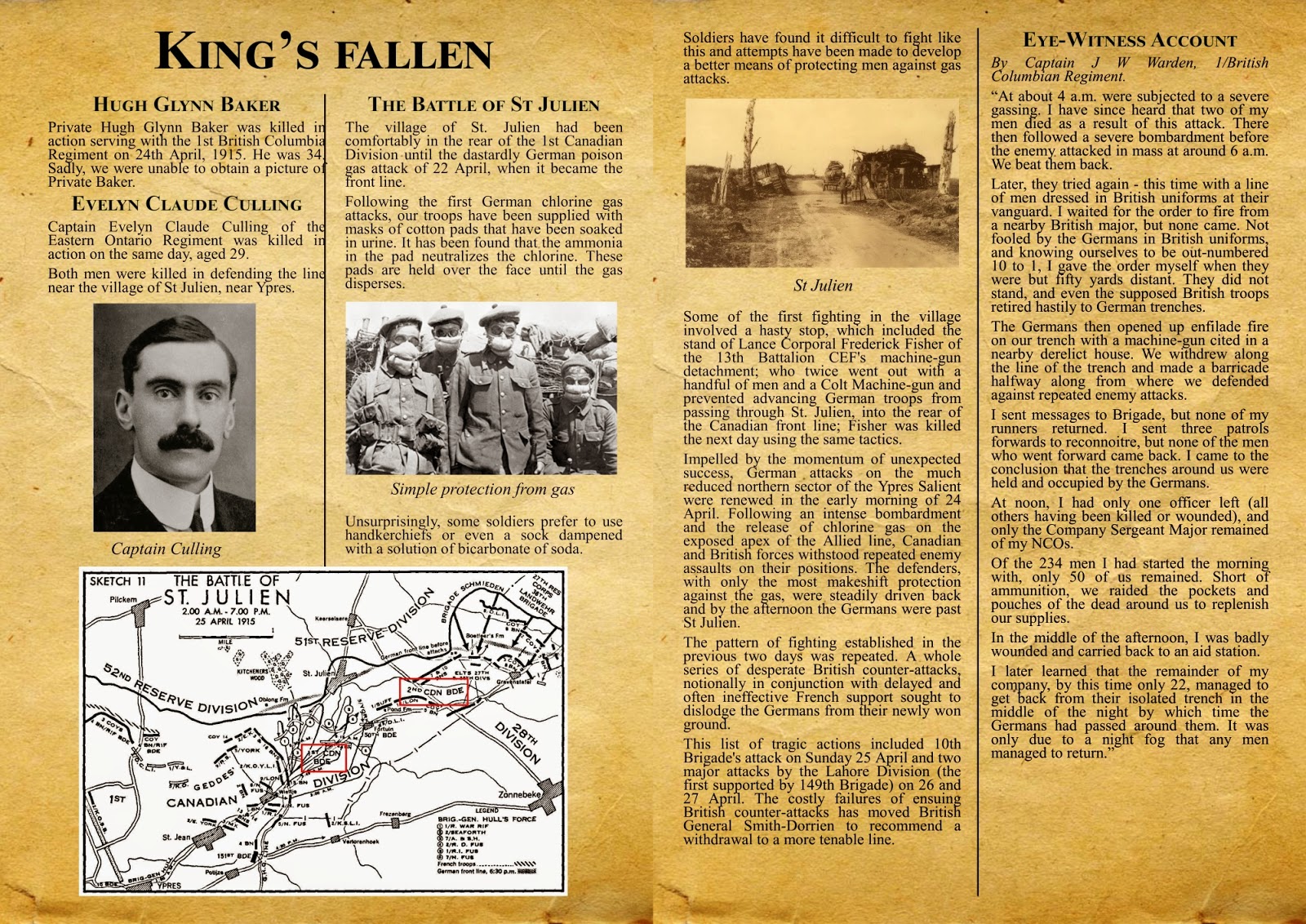
Two King's Bruton Old Boys killed on the same day, serving with the Canadians at Ypres

Private Hugh Glynn Baker was killed in action serving with the 1st British Columbia Regiment on 24th April, 1915. He was 34.

Captain Evelyn Claude Culling of the Eastern Ontario Regiment was killed in action on the same day, aged 29.
The 7th Battalion (1st British Columbia) was part of the 2nd Canadian Infantry Brigade. The 2nd Battalion (1st Eastern Ontario) was part of the 1st Canadian Infantry Brigade. Both brigades were part of the 1st Canadian Division, Canadian Expeditionary Force, and fought in France and Flanders until the end of the war. The action at St Julien was their first real taste of fighting on the Western front.
Map of action at St Julien with both Canadian brigades highlighted
 

Both Hugh and Evelyn were killed fighting in what became known as the Battle of St. Julien, itself part of the Second Battle of Ypres which opened on the 22nd April, 1915, with the Germans using chlorine gas against the French in the line around Ypres.

Private Hugh Glynn Baker 

Sadly, I do not have a picture of Private Baker.

Although the war diary for the 1st British Columbia Regiment does not record details of Hugh's death (generally, only the death of officers are recorded by name in unit war diaries), his company officer wrote details about the engagements in which Hugh was killed. It gives a flavour of the wider campaign.


Hugh's body was never recovered.

Captain Evelyn Claude Culling 


Captain Culling


Again, the battalion war diary does not record the particulars of the death of this company commander, however I have reproduced it here anyway. The 2nd Battalion were fighting to the south west of Hugh's battalion, and casualties on the 24th were heavy.


Evelyn's body was never recovered and he, like Hugh, is remembered on the Menin Gate in Ypres.